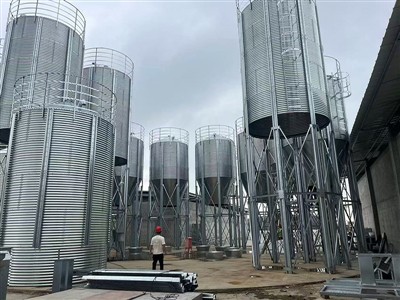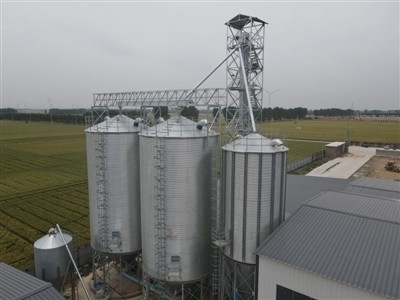
Airtight insulated silos are special storage facilities designed for storing perishable goods such as grains, fruits, and vegetables. Through highly airtight and efficient thermal insulation structures, they achieve a low-temperature, low-oxygen, and constant-humidity storage environment.
Superior Thermal Insulation Performance: The heat transfer coefficient is significantly lower than traditional silo types (e.g., 0.4403 W/m²·K for air-supported membrane silos,
and 1.4782 W/m²·K for shallow circular silos).
The insulation layer uses polyurethane (thermal conductivity ≤0.024 W/m·K), with an insulation effect approximately 70 times that of concrete.
It can achieve "near-low temperature" (≤20℃) or even "low temperature" (≤15℃) grain storage, significantly delaying the deterioration of grain quality.
Superior airtightness
Airtightness exceeds the national high-standard grain warehouse requirements by more than 6 times (half-life reaches 4312 seconds at 500Pa pressure, far exceeding the 300-second standard).
Effectively isolates external temperature, humidity, and oxygen, reducing insect and mold growth, improving fumigation efficiency, and reducing pesticide dosage.
Significant energy savings and consumption reductions:
Occasion cooling and air conditioning temperature control energy consumption are reduced by 10%~50%, and nitrogen-based controlled atmosphere energy consumption is reduced by 30%.
The dome structure prevents rainwater accumulation, ensuring reliable waterproofing and reducing maintenance costs.
Intelligent Monitoring and Green Grain Storage
Built-in multi-point temperature monitoring system (e.g., one temperature monitoring point every 1.85 meters, 350 points in the entire storage).
Supports green grain storage technologies such as nitrogen-filled controlled atmosphere and intelligent temperature control, reducing the use of chemical agents.